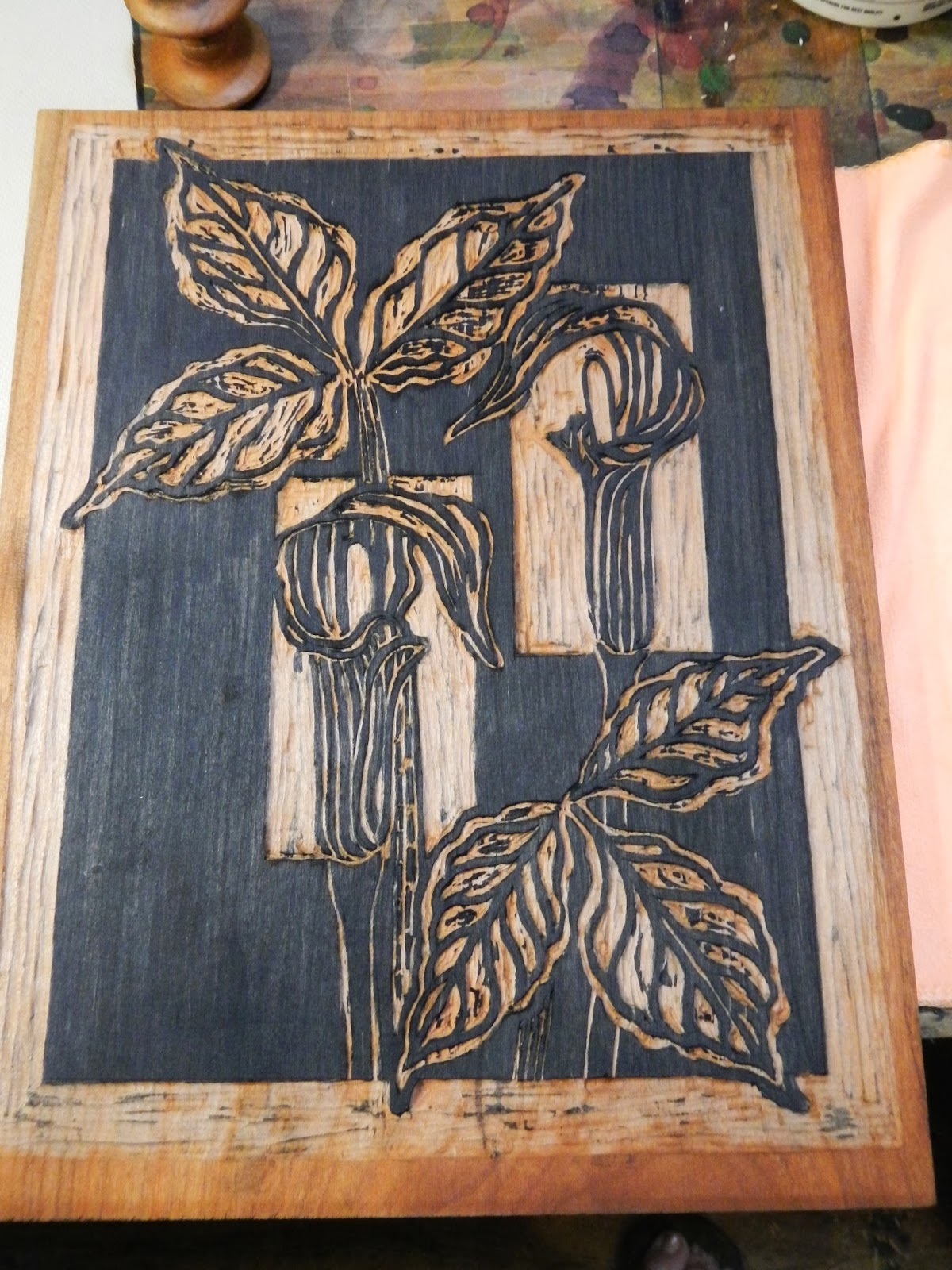
After visiting Audrey Christie's studio in late October, I was inspired to give up linoleum blocks and work with wood. I had the artwork ready for what was to be my largest linoleum print yet, so I put aside the lino block and transferred the image to cherry instead. I've only had time to make a few prints from it, but here they are hanging to dry, along with the block after printing. The image itself is about 10" wide by 13" high. This first printing is in a water based ink, but later, I might print it with water-soluble oil inks so that I can hand color the leaves green and the flowers a burgundy purple color.
Sunday, December 15, 2013
Monday, October 28, 2013
Felted Landscapes for Fall Art Tour 2013
Fall Art Tour is an amazing multi-community event in the Driftless Region of southern Wisconsin where artists' studios are open, with the artists often demonstrating their techniques and methods. Since artists up and down the street and across the street are on the tour, visitors to my gallery on that weekend expect me to be working on something more interesting than maybe putting ear wires onto beaded earrings or finishing the ends on knitted scarves or repolishing the silver jewelry. So most years, I demonstrate the process of making my felted landscapes. In 2013, the subjects were a yellow aspen forest, from a photo my son in Tucson, AZ had taken a couple weeks earlier, a pear branch from a photograph I had used as inspiration for a multi-pane block print I had completed the previous week, and a Jack-In-The-Pulpit from photograph I had been using to complete artwork for another larger block print. This is the status of the landscapes at the end of the Fall Art Tour event; they all still need to be detailed and squared up and framed.
Labels:
felt,
felted,
fiber,
Karma Grotelueschen,
painting
Thursday, October 24, 2013
Weekend Felting Classes at the Gallery
Felting classes are available every Friday evening, from 5 to 6:30 pm or 7 to 8:30 pm and every Saturday morning from 7:00 to 8:30 am or 9 to 10:30 am.
Felting a Vase: We felt around a small glass cylinder vase so that it can be used for fresh flowers or to force branches.
These classes are $30 each for one person or $20 each if there are two or more participating. The gallery can accomodate about 6 people for a class, so feel free to form a group! If you are the first person to sign up, you get to choose what we make. If more people sign up, your cost drops to the group rate.
Bring a bath towel if you can, and a used plastic bag to take home your damp project.
Join me at Prairie Oak Artisans on Friday evening or Saturday morning and explore the fun of felting!
Felting a Vase: We felt around a small glass cylinder vase so that it can be used for fresh flowers or to force branches.
Felting a Scarf: We wet felt a scarf with about an ounce of fleece and warm soapy water. Thse scarfs are warm and durable and can even be given as a gift.
Felted Flowers: We use bits of roving and hot soapy water to wet felt flowers and leaves and tendrils and attach them to pin backs. They can be used as lapel pins, hat pins, to decorate knit mittens or gloves, as holiday ornaments, as gift ties, and anything else you can think of. Each student usually get between 3 and 5 flowers finished.
These classes are $30 each for one person or $20 each if there are two or more participating. The gallery can accomodate about 6 people for a class, so feel free to form a group! If you are the first person to sign up, you get to choose what we make. If more people sign up, your cost drops to the group rate.
Bring a bath towel if you can, and a used plastic bag to take home your damp project.
Join me at Prairie Oak Artisans on Friday evening or Saturday morning and explore the fun of felting!
I can also teach you how to make felted 'paintings' but this class takes 2 sessions and costs twice as much. They can be on the same weekend or on different weekends. I have a collection of photographs of flowers, leaves, trees, and ferns that students choose from as the subject of their 'painting'. During the first session, we wet felt the background mat and any petals or leaves or other pieces that we can. During the second session, we needle felt the picture together, adding yarns and fleece to build up the 'painting'.
I will also teach a group class in the Chicago suburbs, Mineral Point, Reedsburg, the Dells, and anywhere nearby or in between. Find a room at your park district, library, community center, office building, church, recreation center, fitness club, and we can hold a class for up to ten people. In good weather, we can work outdoors, but we should have a back-up location in case of bad weather.
Form a group, find a location, and lets felt together!
Wednesday, October 9, 2013
Monday, July 1, 2013
Newly Painted Sign
In between rain storms, the old sign got a new coat of paint on the letters and leaves. When the sign was new and light colored wood, the dark green letters and brown leaves were just dandy. But over the years (and has it really been eight?), the sign wood has darkeened considerably, so making the letters light green and the leaves a nice rust makes the sign readable again!

Monday, June 3, 2013
Fiber Art Faire at Shake Rag Alley
On June 1 and 2 at Shake Rag Alley, fiber producers and fiber sellers and fiber artists gathered to offer their wares and demonstrate their crafts and arts. I was in the blacksmith shop, a building that my sons actually helped restore as a part of a log cabin workshop a few years back. While I demonstrated wet felting and made scarves and covered vases, Alice demonstrated needle felting. We also offered event attendees an opportunity to try their own hand at wet felting by making a felted flower to put on a pin or make into a hair barette. I love it most when kids take my little workshops and see how good they are at making something oh so lovely!
It was a fabulous weekend, because I got to work nearly outdoor on fiber projects while showing the art to other, but mostly because both of my sons were there with their wonderful girlfriends and kept me company and helped me set up and pack it all back to the gallery at the end of the weekend. Can't wait until next year!

Saturday, May 4, 2013
Opening Day in May 2013
Opening Day on
Friday, May 3, 2013 was an opportunity to put out for display some new jewelry. Samantha Traylor makes earrings of found natural objects like sea glass and uses wire wrapping techniques to turn them into lovely earrings. I just adore that she has the spunk to create deliberately asymmetrical earrings.
Also for the first time, my sterling silver jewelry is available. After being inspired by Wolf Runner, I finally got up the nerve to order tools and supplies and make leaf-themed jewelry with semi-precious cabochons. I must admit I destoyed some silver before I got it right, but it's been a blast. I hope you like it. You can see more on Etsy at my shop PrairieOakArt.
Tuesday, April 23, 2013
Felted Landscapes
These felted landscapes are interpretations of my own nature photographs, constructed by wet-felting the background of the photograph, then needle felting in mid-ground and foreground details. Most are ready for framing.
This woodland landscape features layers of trees and a forest floor pattern of leafy groundcovers.
Hollyhocks stand against the stone wall of a Mineral Point building.
Poppies dance in the sunlight.
Detail from Poppies
Yellow coneflowers wave in a summer breeze in the prairie garden.
Crabapples reflect from the still early morning surface of a lake.
An aspen woodland of contrasting white and green.
Bloodroot is a spring wildflower of the woodlands that is beautiful and fascinating. Green-blue leaves hold water droplets in a shower, delicate flowers attract pollinators, and the sap of the stems and roots is a brilliant orange, giving the plant its name.
Detail of the flower.
The diversity of a prairie flowers from a photo taken at a restoration in late summer.
A nest in the branches of an orchard tree.
Fall colors in a mixed species woodland.
A birdnest nestled into the stems and leaves of a vine.
Hollyhocks stand against the stone wall of a Mineral Point building.
Poppies dance in the sunlight.
Detail from Poppies
Yellow coneflowers wave in a summer breeze in the prairie garden.
Crabapples reflect from the still early morning surface of a lake.
An aspen woodland of contrasting white and green.
Bloodroot is a spring wildflower of the woodlands that is beautiful and fascinating. Green-blue leaves hold water droplets in a shower, delicate flowers attract pollinators, and the sap of the stems and roots is a brilliant orange, giving the plant its name.
Detail of the flower.
The diversity of a prairie flowers from a photo taken at a restoration in late summer.
Fall colors in a mixed species woodland.
A birdnest nestled into the stems and leaves of a vine.
Labels:
botanical illustration,
Fall Art Tour,
felt,
felted,
fiber,
floral,
Karma Grotelueschen,
one of a kind,
painting,
prairie,
woodland
Tuesday, March 19, 2013
Bird Nests
Real birdnests are really too fragile, and often too messy, to bring indoors. Best to leave them out there to decompose and return to the soil to nourish the plants that harbor the animals than to try to bring them inside. But these nests capture the aesthetics of real nests and bring in a message of warmth and nurturing. They shelter a trio of stone 'eggs'.
The black wire nest is on a long branch for display on a wall, but is also available as a table-top version.
Felted nests incorporate a variety of colors and textures of wool fibers and have wooden eggs.
These copper wire nests hold stones selected for their 'egg' shapes and make a lovely windowsill display. They can also be used outdoors as garden art.
All by Karma Grotelueschen.
The black wire nest is on a long branch for display on a wall, but is also available as a table-top version.
Felted nests incorporate a variety of colors and textures of wool fibers and have wooden eggs.
These copper wire nests hold stones selected for their 'egg' shapes and make a lovely windowsill display. They can also be used outdoors as garden art.
All by Karma Grotelueschen.
Thursday, January 3, 2013
Seasonal
Mineral Point is one of those lovely towns that enjoys most of its business in the summer months, so some of the businesses are open limited hours or close down entirely to allow the traffic to be channeled to those that stay open all year.
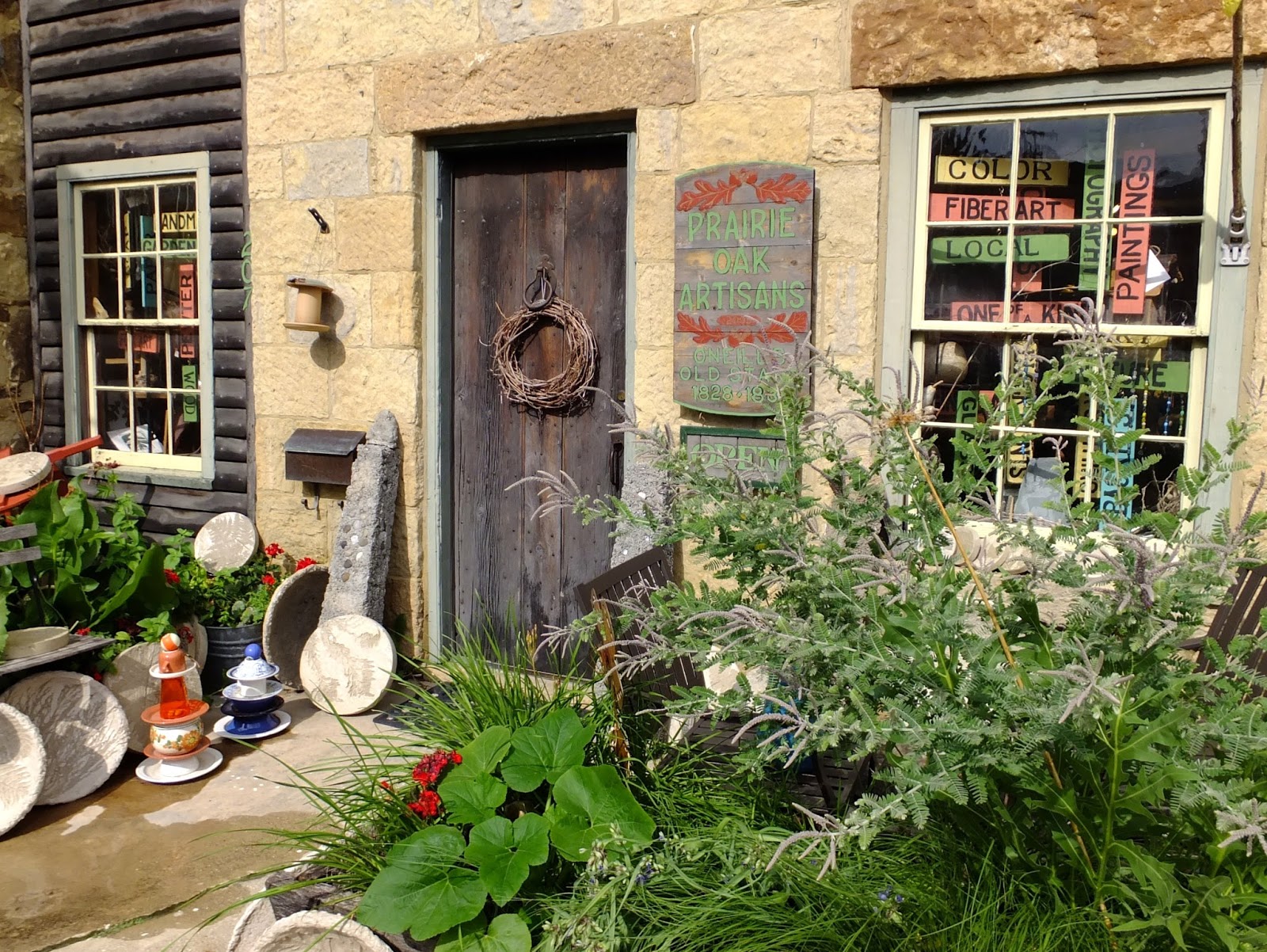
Prairie Oak Artisans is one of the seasonal galleries.
We are open from about the first weekend in May to the last weekend in October, as well as the holiday Candlelight Shopping weekend in December. The rest of the winter months, we are closed.
However, I have people willing to make selections and ship to you, if there is something you have seen in the store during a visit, or something you see here or on our facebook page in a photo.
Just drop me a line via email at plannedscapes at aol.com (take out the spaces) and I will let you know if it is still available and what it would cost to ship. Or if the art is my me, you can find it perhaps in my shop at etsy.com, under the shop name PrairieOakArt or by searching on my name, Karma Grotelueschen.
Or if you are in the area, you can make an appointment to have one of my helpers let you in to make your selections. We are glad to do so to help you with your gift shopping or to get that special pair of earrings or home accessory! Email me as above, or give me a call on my cell phone 630-728-9998. I don't answer numbers I don't recognize, so leave a brief message and I will call you back as soon as I can.
And stop in to see us during our spring through autumn season so you can see what is new or pick up that particular lovely you have had your eye on!
Thanks for you patronage of Prairie Oak Artisans, past, present, and in future seasons!
Prairie Oak Artisans is one of the seasonal galleries.
We are open from about the first weekend in May to the last weekend in October, as well as the holiday Candlelight Shopping weekend in December. The rest of the winter months, we are closed.
However, I have people willing to make selections and ship to you, if there is something you have seen in the store during a visit, or something you see here or on our facebook page in a photo.
Just drop me a line via email at plannedscapes at aol.com (take out the spaces) and I will let you know if it is still available and what it would cost to ship. Or if the art is my me, you can find it perhaps in my shop at etsy.com, under the shop name PrairieOakArt or by searching on my name, Karma Grotelueschen.
Or if you are in the area, you can make an appointment to have one of my helpers let you in to make your selections. We are glad to do so to help you with your gift shopping or to get that special pair of earrings or home accessory! Email me as above, or give me a call on my cell phone 630-728-9998. I don't answer numbers I don't recognize, so leave a brief message and I will call you back as soon as I can.
And stop in to see us during our spring through autumn season so you can see what is new or pick up that particular lovely you have had your eye on!
Thanks for you patronage of Prairie Oak Artisans, past, present, and in future seasons!
Wednesday, October 5, 2011
Timeline of John Falls O'Neill
1806 - John Falls O’Neill "born in Shanes Castle, Ulster, Ireland"
1812 - Mary Ann Sublette, born March 7, Woodford County, Kentucky
1822 - O’Neill arrives in Baltimore, MD and takes job as clerk
1827 - O’Neill accompanies British Army officers to Mexico, on return trip meets Mary Ann Sublette in St. Louis
1827 - O’Neill and Sublette married in Galena on September 18, 1827
1828 - O'Neill have first child, Sarah Ann, October 7, 1828
1829 - O’Neill builds 2 story frame house in Mineral Point. Lower level faces back garden, stream, alley, probably was living level for family. Street level was store, sawmill, lead furnace, etc. Upper level may have been income rental.
1832 - Friend of Sublette’s family killed at Blue Mounds by Winnebago so O’Neill rides in search of killer.
1834 - O'Neills have second child, Louise
1836 - O’Neill is captain at Ft. Richmond in Mineral Point during Black Hawk War
1836 - Mineral Point is surveyed and platted for first time
1836 - O'Neills have third child, Adeline
1837 - O’Neill running 'old stand' out of street level of stone house, probably residing in garden level
1837 - O’Neill applies for claim to ½ of lot 110, states there is a house built as ‘improvement’
1838 - O'Neills have fourth child, William
1840 - O’Neills mortgage lot 110 and house
1840 - O'Neills have fifth child, Thomas
1842 - O'Neills have sixth child, Richard
1844 - O'Neills have seventh child, Eliza
1845 - O’Neills sell lot 109 after a fire damages part of frame portion of buildings, cuts frame house at lot line and limestone building is built adjacent that serves a new wall.
1845 - John Falls O’Neill goes to California to supply merchandise to Gold Rush, apparently making a good deal of money supplying travelers, and at some point, purchases a small ranch in northern California. At some point, he move his family there.
1846 - Lot 110 is foreclosed on
1846 - O'Neills have eighth child, James
1849 - O'Neills have ninth child, Maria
1852 - Captain O'Neill leads a wagon train moving his entire family to a ranch and mine in California.
1886 - O’Neill dies in California and is buried there in the Quincy Cemetery.
1893 - Mary Ann Sublette O'Neill dies in Los Angeles, California
1812 - Mary Ann Sublette, born March 7, Woodford County, Kentucky
1822 - O’Neill arrives in Baltimore, MD and takes job as clerk
1827 - O’Neill accompanies British Army officers to Mexico, on return trip meets Mary Ann Sublette in St. Louis
1827 - O’Neill and Sublette married in Galena on September 18, 1827
1828 - O'Neill have first child, Sarah Ann, October 7, 1828
1829 - O’Neill builds 2 story frame house in Mineral Point. Lower level faces back garden, stream, alley, probably was living level for family. Street level was store, sawmill, lead furnace, etc. Upper level may have been income rental.
1832 - Friend of Sublette’s family killed at Blue Mounds by Winnebago so O’Neill rides in search of killer.
1834 - O'Neills have second child, Louise
1836 - O’Neill is captain at Ft. Richmond in Mineral Point during Black Hawk War
1836 - Mineral Point is surveyed and platted for first time
1836 - O'Neills have third child, Adeline
1837 - O’Neill running 'old stand' out of street level of stone house, probably residing in garden level
1837 - O’Neill applies for claim to ½ of lot 110, states there is a house built as ‘improvement’
1838 - O'Neills have fourth child, William
1840 - O’Neills mortgage lot 110 and house
1840 - O'Neills have fifth child, Thomas
1842 - O'Neills have sixth child, Richard
1844 - O'Neills have seventh child, Eliza
1845 - O’Neills sell lot 109 after a fire damages part of frame portion of buildings, cuts frame house at lot line and limestone building is built adjacent that serves a new wall.
1845 - John Falls O’Neill goes to California to supply merchandise to Gold Rush, apparently making a good deal of money supplying travelers, and at some point, purchases a small ranch in northern California. At some point, he move his family there.
1846 - Lot 110 is foreclosed on
1846 - O'Neills have eighth child, James
1849 - O'Neills have ninth child, Maria
1852 - Captain O'Neill leads a wagon train moving his entire family to a ranch and mine in California.
1886 - O’Neill dies in California and is buried there in the Quincy Cemetery.
1893 - Mary Ann Sublette O'Neill dies in Los Angeles, California
Thursday, September 29, 2011
The Early History of 207 Commerce
Prairie Oak Artisans gallery is housed in a part-frame and part-stone front building at 207 Commerce Street in Mineral Point, Wisconsin. This building is part of a body of historic buildings that survive in Mineral Point. Old buildings carry with them the story of an interesting past and connections to other stories in history. When and why they were built, by whom, how they have survived these many years is a story worthy of telling and retelling. These historical buildings promise a future of fascinating stories only if they are preserved and cared for so that others can experience their beauty and charm and learn about them.
Key to the preservation of old buildings is finding uses for them that make them valuable enough to justify the cost of preservation yet at the same time do not require so many changes as to erase the history. A nature themed art gallery is one possible use for such an historic treasure. Part of the responsibility of owning such an historical building is seeing to it that the history that remains, remains. Thus, sometimes, the gallery can be a little darker than optimal and the walls and floor can be less than ideal backdrops for art, but preserving them is worth the compromise.
When John Falls O'Neill, a real prince from Ireland, where ruins of the family castle remain, came to Mineral Point, it was not even a town. He went touring the area with the British Army as a clerk, and met a young woman in St. Louis that he asked to marry him. Mary Ann Sublette was from a large family of brothers and cousins, some of whom went on to achieve fame in exploration of the west. The O'Neill came to the area that is now Mineral Point to open a general store for the lead prospectors that were already in the area.
O'Neill and his wife built their frame store and home in 1829 so that it was between the road and the creek. There was no town yet and the area had not yet been surveyed. The survey in 1836 resulted in the O'Neil home and store building straddling the line between two lots, so O'Neill purchased them both. Shortly after, he had Cornish stonemasons build the stone portion to span between the original frame building and the lot line. An 1838 newspaper advertisement tells us that a general store was operating out of a stone storefront, so the 'addition' was complete by then.
The shop level faces Commerce Street, and is where O'Neill bought the lead mineral and sold assorted household staples and mining necessities. The "Old Stand", as a general merchant's store was called then, provided needed goods to both the miners and later to the soldier of the fort that was built across the street. They would have offered such goods as flour, sugar, corn and oat meal, spices, coffee, and beer, as well as tools, clothing, socks, cups, bowls, canvas fabric and other supplies and goods to the transient lead miners. As the settlement became a town and grew, offerings in the "Old Stand" would have been adjusted to accommodate the demand. Also offered at various times were various services. One such was sawmilling. O'Neill engaged in the purchase of the raw lead that was being found in the surrounding hills of the driftless region, which he melted down to purify it and formed into ingots for sale at a profit.
The shopkeepers and their families resided in the lower level that opens to the rear to gardens and the stream. This level was finished off in back just like a residential street front, with doors and windows of these and other shop owners facing the creek. The little strips of land between the buildings and the creek would have been considered the 'front yards' to the homes as well as serving as work courtyards. Spring through fall, the family members likely did a good deal of their work outdoors in the fenced yards, such as laundry and even cooking. In the early years, the town had no law and was probably a rather rowdy place, so the women and children probably did all their work in the downstairs level and never set foot in the shop level, and they probably did all their visiting on the rear 'residential street' that is the alley now.
The top level was rented out to others as short term living space and had a separate entrance in the wooden front. Because the lower level had a constant temperature of around 55 degrees with bedrock as walls and as parts of the floor, it would have been cool in summer and naturally warmer than the outdoors in winter, so would have been considered a much better place to live than the drafty top level upstairs.
The front of the building had one door to the store level and another to the upstairs until the 1980's renovation by Jennifer and John Sharp. Their renovation preserved the best of what remained of the history and made major structural restorations that stabilized the building to ensure its continue survival. They used the "Old Stand" level as studio and gallery for Jennifer's water colors and John's wood carving. Merriam Nessett finished the upper level as living space in the late 1990's, and ran an antique and decorating store in the street level gallery.
The oldest standing commercial building in Mineral Point, 207 Commerce is features hand hewn posts and beams in the timber section and limestone walls in the stone section, and mortise and tennon joints and pegged joints can be seen in the walls. The original floors show where the room partitions were, where the heating stoves were, and even show axe marks where firewood for the fires was split and burn marks where coals popped out of the stove and burned pits in the wood. The original oak ceiling joists are exposed in the gallery level showing saw kerfs that reveal that they were 'pit sawn', though such sawing in the area was usually done with above ground frameworks rather than below ground pits due to the proximity of bedrock to the surface. There are remnants of original plaster on the wall that show the first soft gritty thick yellowy layer that was reinforced with horse hair, and the thin hard white or grey surface layer. The attic retains much of the original wood, including a less-than-perfectly-straight ridge beam made of a minimally processed log. The basement has support posts that have also been minimally processed and retain some of their bark. A section of accordion lath that would have formed the structure for plaster on interior walls was rescued from the trash by a neighbor and is on display in the basement stairway.
The street level of the building now serves as gallery space to Prairie Oak Artisans and as my studio space. The upstairs is living space, and the basement is utility and storage. The front and rear gardens feature prairie plants that remind us of what was on the land when Native Americans were the only inhabitants and bison still roamed.
When you are in Mineral Point to shop, feel free to ask questions about the building and its history, and if you want more of a detailed tour before or after hours, call 630-728-9998 to arrange for an appointment. Living and working inside an antique has its challenges, but also its rewards, and I'd love to share them with you!
Key to the preservation of old buildings is finding uses for them that make them valuable enough to justify the cost of preservation yet at the same time do not require so many changes as to erase the history. A nature themed art gallery is one possible use for such an historic treasure. Part of the responsibility of owning such an historical building is seeing to it that the history that remains, remains. Thus, sometimes, the gallery can be a little darker than optimal and the walls and floor can be less than ideal backdrops for art, but preserving them is worth the compromise.
When John Falls O'Neill, a real prince from Ireland, where ruins of the family castle remain, came to Mineral Point, it was not even a town. He went touring the area with the British Army as a clerk, and met a young woman in St. Louis that he asked to marry him. Mary Ann Sublette was from a large family of brothers and cousins, some of whom went on to achieve fame in exploration of the west. The O'Neill came to the area that is now Mineral Point to open a general store for the lead prospectors that were already in the area.
O'Neill and his wife built their frame store and home in 1829 so that it was between the road and the creek. There was no town yet and the area had not yet been surveyed. The survey in 1836 resulted in the O'Neil home and store building straddling the line between two lots, so O'Neill purchased them both. Shortly after, he had Cornish stonemasons build the stone portion to span between the original frame building and the lot line. An 1838 newspaper advertisement tells us that a general store was operating out of a stone storefront, so the 'addition' was complete by then.The shop level faces Commerce Street, and is where O'Neill bought the lead mineral and sold assorted household staples and mining necessities. The "Old Stand", as a general merchant's store was called then, provided needed goods to both the miners and later to the soldier of the fort that was built across the street. They would have offered such goods as flour, sugar, corn and oat meal, spices, coffee, and beer, as well as tools, clothing, socks, cups, bowls, canvas fabric and other supplies and goods to the transient lead miners. As the settlement became a town and grew, offerings in the "Old Stand" would have been adjusted to accommodate the demand. Also offered at various times were various services. One such was sawmilling. O'Neill engaged in the purchase of the raw lead that was being found in the surrounding hills of the driftless region, which he melted down to purify it and formed into ingots for sale at a profit.
The shopkeepers and their families resided in the lower level that opens to the rear to gardens and the stream. This level was finished off in back just like a residential street front, with doors and windows of these and other shop owners facing the creek. The little strips of land between the buildings and the creek would have been considered the 'front yards' to the homes as well as serving as work courtyards. Spring through fall, the family members likely did a good deal of their work outdoors in the fenced yards, such as laundry and even cooking. In the early years, the town had no law and was probably a rather rowdy place, so the women and children probably did all their work in the downstairs level and never set foot in the shop level, and they probably did all their visiting on the rear 'residential street' that is the alley now.
The top level was rented out to others as short term living space and had a separate entrance in the wooden front. Because the lower level had a constant temperature of around 55 degrees with bedrock as walls and as parts of the floor, it would have been cool in summer and naturally warmer than the outdoors in winter, so would have been considered a much better place to live than the drafty top level upstairs.
The front of the building had one door to the store level and another to the upstairs until the 1980's renovation by Jennifer and John Sharp. Their renovation preserved the best of what remained of the history and made major structural restorations that stabilized the building to ensure its continue survival. They used the "Old Stand" level as studio and gallery for Jennifer's water colors and John's wood carving. Merriam Nessett finished the upper level as living space in the late 1990's, and ran an antique and decorating store in the street level gallery.
The oldest standing commercial building in Mineral Point, 207 Commerce is features hand hewn posts and beams in the timber section and limestone walls in the stone section, and mortise and tennon joints and pegged joints can be seen in the walls. The original floors show where the room partitions were, where the heating stoves were, and even show axe marks where firewood for the fires was split and burn marks where coals popped out of the stove and burned pits in the wood. The original oak ceiling joists are exposed in the gallery level showing saw kerfs that reveal that they were 'pit sawn', though such sawing in the area was usually done with above ground frameworks rather than below ground pits due to the proximity of bedrock to the surface. There are remnants of original plaster on the wall that show the first soft gritty thick yellowy layer that was reinforced with horse hair, and the thin hard white or grey surface layer. The attic retains much of the original wood, including a less-than-perfectly-straight ridge beam made of a minimally processed log. The basement has support posts that have also been minimally processed and retain some of their bark. A section of accordion lath that would have formed the structure for plaster on interior walls was rescued from the trash by a neighbor and is on display in the basement stairway.
The street level of the building now serves as gallery space to Prairie Oak Artisans and as my studio space. The upstairs is living space, and the basement is utility and storage. The front and rear gardens feature prairie plants that remind us of what was on the land when Native Americans were the only inhabitants and bison still roamed.
When you are in Mineral Point to shop, feel free to ask questions about the building and its history, and if you want more of a detailed tour before or after hours, call 630-728-9998 to arrange for an appointment. Living and working inside an antique has its challenges, but also its rewards, and I'd love to share them with you!
Wednesday, October 27, 2010
Fall Art Tour 2010
Fall Art Tour happens on the third weekend of October each year in the Mineral Point area. While not actually on the tour map, I am surrounded by those who are and so I demonstrate one of my media on that day.
This year again, I was felting. Working with images from my nature photographs, I pre-make the wet-felted background mats during the week prior, and then during the event, add details and foreground images to the mats with needle felting. Felting needles have fine notches along their edges that grab the fibers of the yarns or wool fleece and push them into the felted mat to hold them onto it. This process builds up an artwork image much like layers of oil painting are built up. The finished images are about 9 inches by about 13 inches and are available as is for your own framing or in a shadowbox frame. Both works need some finishing touches such as squaring up the edges, but these are my results for FAT 2010.

This year again, I was felting. Working with images from my nature photographs, I pre-make the wet-felted background mats during the week prior, and then during the event, add details and foreground images to the mats with needle felting. Felting needles have fine notches along their edges that grab the fibers of the yarns or wool fleece and push them into the felted mat to hold them onto it. This process builds up an artwork image much like layers of oil painting are built up. The finished images are about 9 inches by about 13 inches and are available as is for your own framing or in a shadowbox frame. Both works need some finishing touches such as squaring up the edges, but these are my results for FAT 2010.

During the event, I also made a felted vessel by wrapping roving around a children's play ball and wet felting it. This forms a hollow vessel of felted fiber. This yellow-orange and rust vessel is about 8 inches wide and about 7 inches tall.The felted oak leaves will be $380 unframed or $420 framed plus $25 shipping. The trilliums will be $420 unframed or $460 framed, plus $25 shipping. The vessel is $85 plus $5 shipping. Call 630-728-9998 or email. Other vessels and felted pictures are available.
Labels:
event,
Fall Art Tour,
felt,
felted,
fiber,
gallery,
Karma Grotelueschen,
one of a kind,
vessel,
woodland
Wednesday, September 29, 2010
Natural Wool Scarves
.jpg)
While at the Fibre Art Faire, I worked up a few scarves using Icelandic wool roving from a local fiber processor, the Argyle Fiber Mill, in Argyle, Wisconsin. These scarves, like my vibrant colored ones, use about an ounce of wool, so are light and airy to wear. The wool is not dyed but rather the natural color of the sheep, so the scarves have gorgeous muted tones of ivory, browns, and grays. Never having been dyed means the wool fibers have not been damaged by the chemicals in the dyes and are very soft and smooth. These scarves have a luxurious feel that makes you feel pampered and special when you wear them.
Sunday, September 19, 2010
Septermber 25 and 26, 2010
Next weekend, La Bella Vita yarn and fiber shop will be hosting a Fibre Arts Faire, and I will be there demonstrating felting. I will be demonstrating live at the show at 109 Commerce, which is block downhill from my gallery, while friendly helpers run the shop! These are examples of the felt scarves I will be making at the show.

Labels:
felt,
fiber,
floral,
Karma Grotelueschen,
scarves,
wearable art
Saturday, September 18, 2010
Woodburned and Painted Boxes
My friend Susie does amazing folk art painting and I hope to have her work at the gallery SOON. One of my favorite things that she does is these heart shapes that have bold geometric bands of black and white and assorted vines and berries. She woodburns the designs first, then paints them. I have had these wood boxes stashed for a while, and Susie's art inspired me to do some woodburning and painting of my own.
Instead of opaque paints, I used calligraphy ink so that the wood grain shows through. They are lightly varnished to protect the artwork.
Labels:
boxes,
folk art,
folk painting,
ink,
Karma Grotelueschen,
leaves,
wood,
woodburning
Subscribe to:
Posts (Atom)